
This post will show a way to calculate the diameter and radius of the sun. These values can be determined from the angular width of the Sun viewed from the Earth and using simple trigonometry.
The following need to be obtained from elsewhere:
r = average Sun-Earth distance = 134030000 km (get from solution to one of my previous science posts)
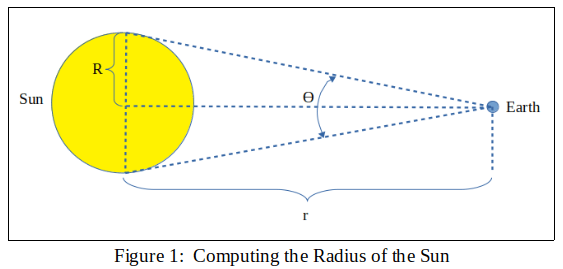
ϴ = Mean apparent angular diameter measured from the Earth = 1919″ = 0.53310 = 0.00930435 radians
(see the NASA Fact Sheets)
The following will be calculated:
R = Radius of the Sun
D = Diameter of the Sun
Calculate the radius of the sun:
From trigonometry we have:
tan(ϴ/2) = R / r
Solving for R we get:
R = r * tan(ϴ/2)
R = (134030000 km) * tan(0.00930435/2)
R = 623536 km
Calculated value of radius of Sun = 623536 km
Modern value of radius of Sun = 695700 km
Percent difference = 10.4%
Calculate the diameter of the sun:
The diameter of the Sun is double its radius:
D = 2*R = (2)*(623536 km)
D = 1247071 km
Sources of error:
The sources of error in this approximation are the uncertainty in the values of the average Sun-Earth distance (computed in one of my previous science posts) and the Sun’s mean apparent angular diameter measured from the Earth. Also, it is not clear from the NASA Fact Sheets whether the Sun’s mean apparent angular diameter was adjusted so that it represents an angle “measured” from the center of the Earth. If it is measured from the surface of the Earth then a slight error would be introduced into the calculation of the Sun’s radius.
If we use the modern value for the average Sun-Earth distance, we get a vast improvement:
Modern value for average Sun-Earth Distance: 148090000000 meters
Approximate Sun radius (using modern average Sun-Earth distance) = 688946 km
The percent difference from the modern value is: 0.97%
Source of modern values for diameter and radius of the sun:
The modern value of the Sun’s radius was determined from measurements of Venus’s transits across the Sun’s edges. The measurements were made by instruments aboard the PICARD spacecraft. In order to improve the precision the measurements were taken from several wavelengths of sunlight.
(See: https://www.aanda.org/articles/aa/full_html/2018/08/aa32159-17/aa32159-17.html)
The modern values I quote for the solar system parameters are from the NASA Fact Sheets, located at:
https://nssdc.gsfc.nasa.gov/planetary/factsheet/
The notes on the NASA Fact Sheets state the following:
“Note that the values listed on the fact sheets are not “official” values, there is no single set of agreed upon values. They are based on ongoing research and as such are under study and subject to change at any time.
Every effort has been made to present the most up-to-date information, but care should be exercised when using these values.”